For the Digital Vanguard Fellows
Neural networks were the mechanism. This is what LLMs actually are.
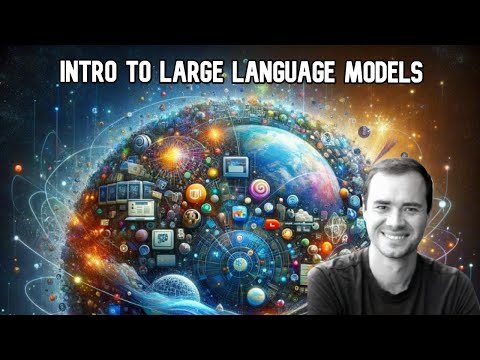
[1hr Talk] Intro to Large Language Models
A general-audience walkthrough of what powers ChatGPT, Claude, and every model like them, from someone who has actually built these systems at the frontier. Covers where LLMs are headed and the real security challenges of this new computing paradigm.
An LLM is a neural network (Issue No. 2's mechanism) trained on a specific task: predict the next word, over and over, across a huge slice of the internet. That's genuinely most of it. Everything that feels like "understanding," reasoning, chatting, writing code, emerges from that one simple training objective at enormous scale. Karpathy's framing worth remembering: think of an LLM less like a search engine and more like a new kind of operating system, one you talk to instead of click through.
Anyone can use ChatGPT. Almost nobody in a room can explain, correctly and simply, why it works the way it does, including its real limitations (it can be confidently wrong, it has no persistent memory unless you build one for it). That gap between "user" and "person who understands the mechanism" is exactly the gap Morgan is training you to close, and it applies whether your lane is pure software or something more hands-on. If you're coming at this from engineering, robotics, or a hardware-adjacent discipline, the same mechanism (predict the next token, at scale) is what's starting to show up inside embedded systems and applied ML pipelines, not just chatbots.
The UN just said, on the record, that nobody can guarantee AI is safe.
UN Global Dialogue on AI Governance
The United Nations just held its first-ever formal AI governance summit. Alongside it, the UN's Independent International Scientific Panel on AI, co-chaired by Yoshua Bengio (one of the most cited AI researchers alive) and journalist Maria Ressa, released its inaugural report. Forty scientists, every region of the world, one conclusion stated plainly: "Science currently cannot guarantee that AI will not cause catastrophic harm."
This is a governance-first document, not an innovation-first one. It explicitly named the US-China concentration of frontier AI models as a structural risk, not just a competitive dynamic. When the UN's own scientific panel says the safety science hasn't caught up to the capability, that's not fear-mongering, it's an honest admission that the field is moving faster than anyone's ability to fully verify it's safe. That gap, between what AI can do and what we can prove about what it will do, is exactly the space governance and sovereign AI infrastructure exist to manage.
Every guild here touches this, but if you're building toward cybersecurity and governance work specifically: this is the exact reason governance isn't paperwork, it's protection. When the UN's own scientists say "we can't guarantee this is safe," that gap between what AI can do and what we can prove about what it will do is precisely the space where real harm reaches real people first, especially communities with the least power to demand accountability. Being able to explain, in one sentence, why that gap is the argument for institutions owning their own AI infrastructure, is a governance skill with teeth.
Three regulatory blocs, moving apart
All three of these happened within days of each other. The US is accelerating deployment of its most capable frontier model. China is reportedly considering a "silicon curtain," restricting outside access to its own top models, mirroring the export controls the US already placed on China. The EU, meanwhile, just rolled out a Cybersecurity x AI Action Plan requiring mandatory model evaluation before anything touches its market.
These are not three unrelated news stories. They're the same event seen from three different governments: the world's major powers are no longer trying to build one shared set of AI rules, they're building incompatible regional ones. An institution, or a country, caught in the middle of that, using someone else's AI tools without owning its own stack, ends up squeezed between rules it doesn't control. That's not an abstract policy point. It's the exact reason "sovereign AI" isn't a marketing phrase, it's a structural necessity for any institution that wants a seat at the table rather than being a tenant of someone else's rules.
You can now say, with a straight face and real evidence behind it, that Morgan built Obsidian at exactly the moment the rest of the world figured out why that was the right call. That's not a talking point I'm handing you, it's something you can defend in a room because you understand the underlying mechanism: fragmenting regulation rewards institutions that own their own infrastructure, and punishes the ones that don't.
Issue No. 2 gave you hygiene. This is how institutions actually govern AI risk.
AI Risk Management Framework (AI RMF)
The U.S. government's own voluntary framework for managing AI risk, developed with industry, adopted as a reference standard across higher ed and government alike. NIST has an active Generative AI Profile and an in-progress Critical Infrastructure Profile as of 2026.
The AI RMF organizes AI governance into four functions: Govern (set the culture and accountability structure), Map (understand the context and risks of a specific AI system), Measure (assess and track those risks with real metrics), and Manage (act on what you find). This is not abstract theory, it's close to a literal spec for what Obsidian's Ledger already does: every interaction logged, every risk traceable, every decision auditable. When you can name "Govern, Map, Measure, Manage" in a room, you're speaking the same language as the federal government's own AI risk standard.
Every guild, not just Cybersecurity & Sovereignty, will eventually build something that touches institutional data. Being able to say "here's how this maps to Govern, Map, Measure, Manage" in a review is the difference between someone who builds responsibly and someone who has to be told to. If you're going deep on cybersecurity specifically: this framework is a genuinely useful lens for a question worth asking on every system you touch, not just "does this work," but "who does this fail, and how would we know." That's the real substance behind "governance," not paperwork for its own sake.
Issue No. 2 asked "what's the specific task?" This is why that question is about to matter even more.
The 2026 State of Marketing Report
HubSpot's flagship annual marketing research, built from its own customer base and marketing leadership. The headline finding reframes the entire AI-in-marketing conversation.
"AI is the baseline, not the differentiator." In 2026, virtually every marketing team has access to AI tools. That means having AI is no longer a competitive advantage, using it well is. HubSpot's own data points to a second, sharper insight: as AI floods every channel with content, brands with a genuinely clear point of view stand out, and the ones without one get lost in the noise. The report's third finding closes the loop: audiences still reward marketing that feels human, authentic, and helpful over marketing that feels automated at scale. Put together: AI execution is table stakes; brand clarity and human trust are the actual competitive edges now.
This is the exact same lesson as Issue No. 2's Business + AI concept, "we use AI" is not a strategy, just applied one level up: in marketing specifically, "we use AI for content" is now the bare minimum, not the pitch. The real skill is being able to say what your brand's point of view is, and how AI helps you execute it faster without diluting it.
8 Marketing Automation Trends for 2026
Klaviyo interviewed 13 marketing automation experts and agency leaders directly (not just aggregated survey data) about what's actually changing in how campaigns get built and run.
Marketing automation is moving through two distinct stages this year. Stage one, already happening: AI as copilot, drafting flows, testing message variations, personalizing at scale, while a human still directs the strategy. Stage two, just beginning: autonomous orchestration, where systems plan, execute, and adjust entire campaigns across channels in real time, reacting to customer behavior without waiting for a human to approve each step. One practitioner's framing is worth remembering directly: "The winners will be brands that know how to train AI on their tone, not just prompt it." That's the real skill, teaching a system your brand's actual voice, not just issuing it one-off instructions.
"Copilot vs. autonomous" is a genuinely useful lens to bring into any conversation about AI and marketing, in an interview or in the field. Most people can only describe AI marketing tools as "using AI for content." Being able to name which stage a given tool or workflow actually operates at, assistant or autonomous, signals real fluency, not just familiarity.
AI Is Rewiring How Marketing Is Understood, Shaped and Scaled
Written by a working CMO (Sairam Vedam, Coforge), not a trend-piece writer, this is the missing strategic layer on top of the copilot/autonomous distinction above: what happens to the marketer's actual job once execution keeps getting automated.
Gartner projects 36% of marketing activities will be automated by 2028, with nearly a third of marketing organizations already running AI agents. The CMO's real point: as execution automates, marketing's job shifts up, from "demand generation" (react to demand that already exists, run the campaign) to "demand shaping" (influence how customers evaluate value and what they expect, before a buying decision is even made). The organizations that win by 2028 won't be the ones with the biggest ad budget, they'll be the ones that shape what the market expects before competitors do. This is a genuine strategic promotion path: execution gets automated, judgment and market intelligence become the actual job.
This is the piece that connects your marketing execution background to the strategic level an MBA is pointed at. The workflows and content calendars you've already mastered are exactly what's being automated next, which isn't a threat, it's the promotion path: the marketers who get to "demand shaping" work are the ones who can already prove their execution work drove a measurable outcome. Keep doing what you already do well (Google Analytics reporting, campaign metrics, structured workflows), and start naming, explicitly, the strategic judgment behind each one. That's the resume line that gets you into the room this piece describes.
Superposition and entanglement were the mechanism. Here's how you actually touch one.
"Hello Qubit" — Your First Quantum Program
Google's own beginner on-ramp to Cirq, and it's genuinely built to not be intimidating. It runs directly in Google Colab, a free notebook in your browser, no install, no setup, no local Python environment required. Five lines of real code: pick a qubit, apply one gate, measure it 20 times, look at the results.
You're not simulating an abstraction, you're running a real quantum program (on a simulator standing in for hardware) and watching it produce a string of measurement outcomes that looks like 10011000011110010110, a coin that's landed on both heads and tails across 20 flips, because the gate you applied put the qubit into superposition first. That's it. That's the whole first step: pick a qubit, do something to it, measure what happens. Everything more advanced, including the QAOA optimization technique below, is built out of exactly this same three-step pattern, just repeated and combined at scale.
The single biggest barrier to quantum computing isn't the math, it's the intimidation of never having actually touched it. This removes that barrier in under five minutes. You don't need to fully understand superposition to run this notebook; you need to run this notebook to start actually understanding superposition. Do this one before the QAOA piece below, it's the on-ramp, not a detour.
Quantum Approximate Optimization Algorithm (QAOA)
Google's own open-source quantum programming framework, Cirq, includes a hands-on tutorial for writing a real QAOA implementation, the leading technique for using quantum computers on optimization problems (scheduling, routing, resource allocation) rather than language or search. It runs entirely on a simulator, no quantum hardware required to learn it.
QAOA doesn't try to brute-force every possible answer. It uses superposition to explore many candidate solutions at once, then uses a feedback loop between a quantum and a classical computer to steadily nudge the system toward better answers, closer to "guided search across possibilities" than "magic parallel computer." This is the exact mechanism behind the hybrid quantum-classical Decision Layer concept currently being scoped as a research thread in this cohort: a real, working algorithm, not a hypothetical.
Quantum computing's job market barely exists yet, which means there's no gatekeeping and no established path. The people who can say "I've actually run a QAOA circuit" instead of "I've read about quantum computing" are already ahead of nearly everyone applying to the field's first wave of real roles. This is also a genuinely good example of a cross-disciplinary problem, optimization shows up in scheduling, logistics, finance, and engineering alike, so it's worth a look even if quantum isn't your primary lane.
- Explain it in 60 seconds: pick either current-events story above and explain it out loud, from memory, to someone who's never heard of Obsidian. Land the "why sovereignty matters" point without using the word "sovereign."
- Your guild's angle: whichever guild you're in, name one concrete way this week's regulatory fragmentation changes what your guild should be building or protecting against.
- The honest test: if a reporter asked you "isn't 'sovereign AI' just marketing language," what's your actual answer, backed by this week's news, not a talking point?
- Connect the Level 2 dots: the NIST AI RMF's "Govern, Map, Measure, Manage" is a formal version of something Obsidian's Ledger already does. Explain that connection in your own words.
- Try it: open the "Hello Qubit" Colab notebook and actually run it, it takes about five minutes and needs no install. Then, if you're curious to go further, look at the Cirq QAOA tutorial too, no need to run that one yet. Tell me one thing that surprised you about how any of it actually works.
- For Kenya: pick one thing you already do well (a report, a workflow, a campaign metric) and write one sentence naming the strategic judgment behind it, the "demand shaping" version of that task, not just the execution.
- For everyone else on Track 03: pick a brand you follow that uses AI in its marketing. Is it operating as a "copilot" (a human clearly still steering) or heading toward "autonomous orchestration"? What's your evidence either way?