For the Digital Vanguard Fellows
What a neural network actually is.
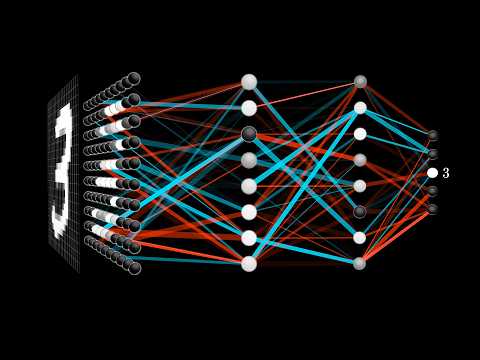
But what is a neural network?
The clearest visual explanation of neurons, layers, weights, and how a network actually "decides" anything, built by a former Khan Academy team member turned math educator, watched by millions of engineers as their first real introduction to the topic.
A neural network is not "thinking." It's a giant function that takes numbers in, multiplies and adds them through layers according to weights it learned from examples, and produces numbers out. "Learning" just means slowly adjusting those weights so the output gets closer to correct. That's it. Everything else you'll hear about AI, from chatbots to image generators, builds on this one mechanism.
When a hiring manager or a client asks "how does AI actually work," most candidates either dodge the question or recite marketing language. Being able to explain this mechanism simply and correctly, in under a minute, is an instant credibility signal. Practice explaining this to a non-technical friend before our next convening.
AI in Higher Education Global Survey 2026
One of the largest datasets ever assembled on AI adoption in higher ed: 45,398 responses (27,284 students, 18,114 faculty) across 35 countries. This is the honest, current picture of where universities actually are with AI, not the marketing version.
AI integration in courses is still uneven: only 15% of students say AI is integrated into many of their courses, and 43% say they've seen none at all. Where it is used, the payoff is mixed, only 5% of students say it's transformed how they learn. Trust is a real issue too: 60% of students globally worry classmates are misusing AI for unfair advantage (73% in the US & Canada). And only 29% of students believe their instructors are well-equipped to guide them on AI use, even though 64% of faculty say they've completed AI literacy training, a real gap between training and felt readiness.
This is the exact gap Morgan is trying to close with Obsidian and the AI Fluency Initiative, most institutions have AI tools but not AI literacy. Understanding this gap in concrete numbers means you can explain, with real evidence, why Morgan's approach (data literacy first, infrastructure second) is ahead of where most universities actually are right now.
AI in Higher Education: Widespread Use, Unclear Rules
A national Gallup survey of nearly 4,000 U.S. associate and bachelor's degree students, on exactly the tension Morgan is trying to solve: students are already using AI constantly, but most schools' policies haven't caught up.
57% of college students use AI in their coursework daily or weekly, only 13% never do. Yet 53% of students say their school discourages or outright prohibits AI use, and students still use it anyway: 48% at "discouraging" schools, 27% even at schools that prohibit it outright. Rules aren't stopping the behavior, they're just leaving 52% of students without clear course-level policy on how to use it responsibly. The clearest signal: students at schools that actively encourage AI use are far more likely (87%) to use it weekly and feel adequately trained on it, compared to students at restrictive schools, who are both less trained and still using it anyway. The data says clearly: banning AI doesn't work, teaching it does.
This is the single strongest piece of evidence for why Morgan's approach, the AI Fluency Initiative, Obsidian, data literacy programs, is the right strategic bet, not just a nice-to-have. Most universities are choosing the "discourage and hope" path this data proves doesn't work. Being able to cite this exact study in a room is a real credibility move: it turns "Morgan trains people on AI" from a slogan into a strategy backed by 3,801 students' worth of national evidence.
Cyber hygiene: the four habits that stop most attacks.
Cybersecurity Best Practices
The federal government's own plain-language breakdown of "cyber hygiene," the small number of habits that prevent the overwhelming majority of real-world breaches.
1. Strong, unique passwords (or better, a password manager) so one leaked password doesn't unlock every account. 2. Multi-factor authentication (MFA) everywhere it's offered, this alone stops the majority of account-takeover attacks even with a stolen password. 3. Keep software updated, most breaches exploit known vulnerabilities that a patch already fixed. 4. Think before you click, phishing (fake links/emails designed to steal credentials) is still the most common way attackers get in the door.
Every guild, not just Cybersecurity & Sovereignty, will be evaluated on whether the systems you build follow these basics. In an interview, being able to name MFA, patching cadence, and phishing awareness as your "baseline security posture" signals you think about security by default, not as an afterthought.
Why most companies still waste their AI investment.
Why AI Agents Define The Future Of Business
The industries actually winning with AI right now share one trait: clear, repeatable workflows with measurable outcomes, not vague "let's use AI for everything" mandates.
AI creates business value when it's pointed at a specific, repeatable, measurable task, not when it's deployed as a vague company-wide initiative. "We use AI" is not a strategy. "AI now handles our first-pass customer support triage, cutting response time from 6 hours to 4 minutes" is a strategy. The gap between those two sentences is the entire skill of business + AI.
Whatever guild you're in, someone will eventually ask you to "add AI" to a project. The skill isn't knowing every AI tool, it's knowing how to ask "what specific, repeatable task are we improving, and how will we measure it?" That question alone puts you ahead of most people in the room.
The one idea that makes quantum computing make sense.
What Is Quantum Computing?
IBM's own foundational explainer: what quantum computers actually are, what they're good for, and where the real research challenges still are, written by IBM's own quantum researchers, not a marketing team.
A classical computer's bit is always either 0 or 1. A quantum computer's qubit can be in a mix of both at once, called superposition, and multiple qubits can be linked together so that measuring one instantly affects what you'd measure on the others, called entanglement. Together, these let a quantum computer explore many possible answers to certain problems simultaneously instead of one at a time. It won't replace your laptop, it's built for a narrow class of extremely hard problems (like modeling molecules or optimizing huge systems) where this shortcut actually helps.
Quantum computing doesn't have an established hiring pipeline yet, no standard bootcamp, no obvious on-ramp. That means the people who build real fluency now, even at this foundational level, are positioning themselves years ahead of a field that's about to explode in relevance.
- The 60-second test: pick one of the four concept boxes above and explain it out loud, from memory, in under 60 seconds. If you can't yet, that's exactly the right thing to work on before we meet.
- Cross-guild connection: pick two of the four tracks above and identify one real way they intersect in a project you could imagine building at Morgan.
- Your own gap: of the four tracks, which one do you already feel confident in, and which one do you want the next issue to go deeper on first? Tell me directly, this determines where I put the most depth next.
- The business question: think of one process in your own guild that could become "AI now handles X, cutting Y from A to B." Even a rough draft is useful, that's the actual skill we're building.